


SOURCES
Historical records about Caresto
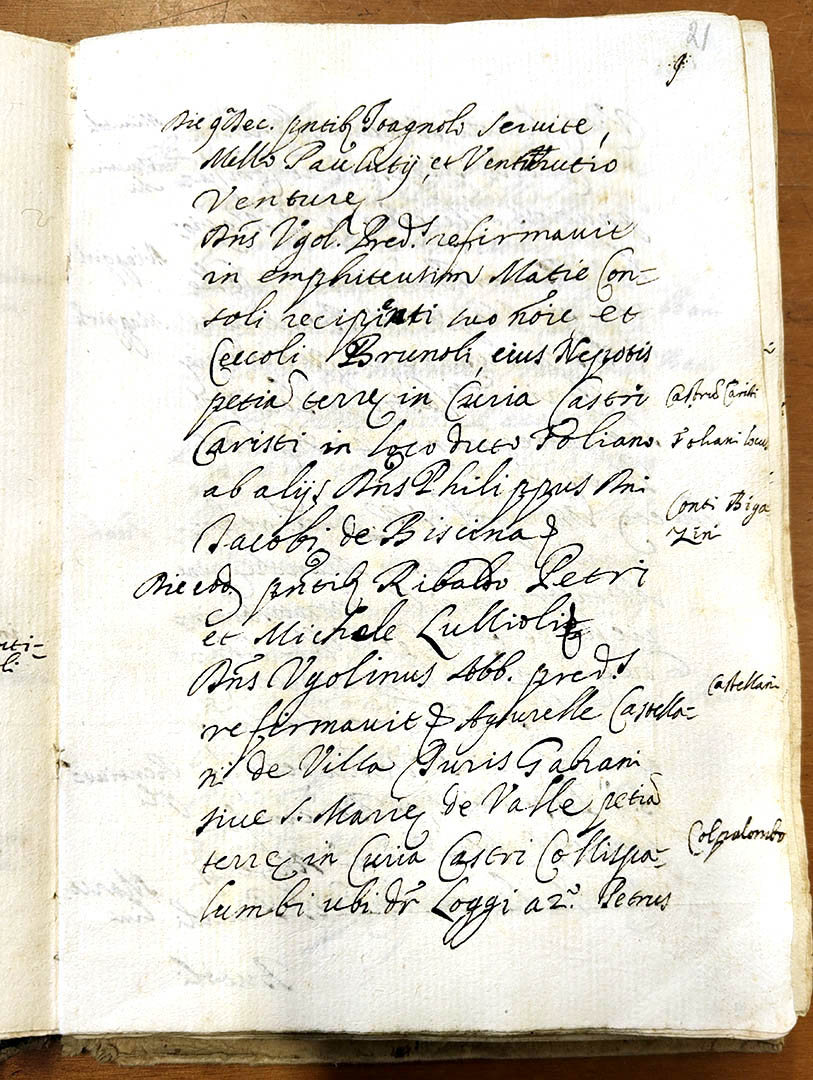
Caresto, 1312: the first evidence of the castle
The consul of the Municipality of Gubbio secures the renewal of a lease
On 9 December 1312 dominus Ugolino renewed console the emphyteusis (long-term lease) of a plot of land near Foliano, in the territory of Caresto, to Matia, the consul of Gubbio.
In the public deed—of which this is a transcript produced around the mid-17th century—Caresto is presented for the first time as a curia castri, meaning a fortified settlement guarding a wider territory that included other scattered hamlets.
Among the neighbouring landowners were the lords Filippo and Jacopo de Biscina demonstrating the interests of families from other localities in the complex agricultural, infrastructural, and defensive system that stretched along the course of the Chiascio river.
Shelfmark: State Archives of Perugia, Gubbio Section, Fondo Armanni, I-B-13, f. 9
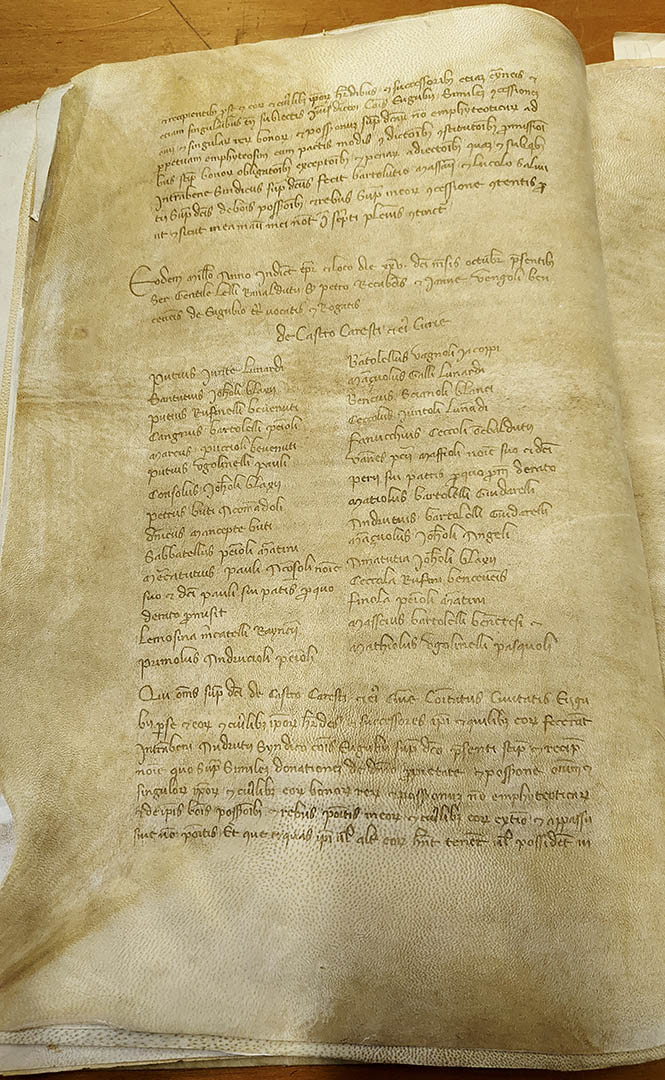
Caresto, 1345: the first list of families
The community of Caresto is subject to the city of Gubbio
Within a register of donations, grants, and leases of the Municipality of Gubbio, the names of 28 inhabitants who made up the community of Caresto are presented to us for the first time.
These individuals lived within the cluster of scattered localities subject to the curia , and each of them was the representative of a household, or fuoco (hearth).
The deed, drawn up on 25 October 1345, is recorded among those relating to the San Pietro district. This demonstrates that, despite the physical distance, the Castle of Caresto was considered, to all intents and purposes, part of the city of Gubbio.
Shelfmark: State Archives of Perugia, Gubbio Section, Fondo Comunale, Libro donationum, no. 14, f. 14
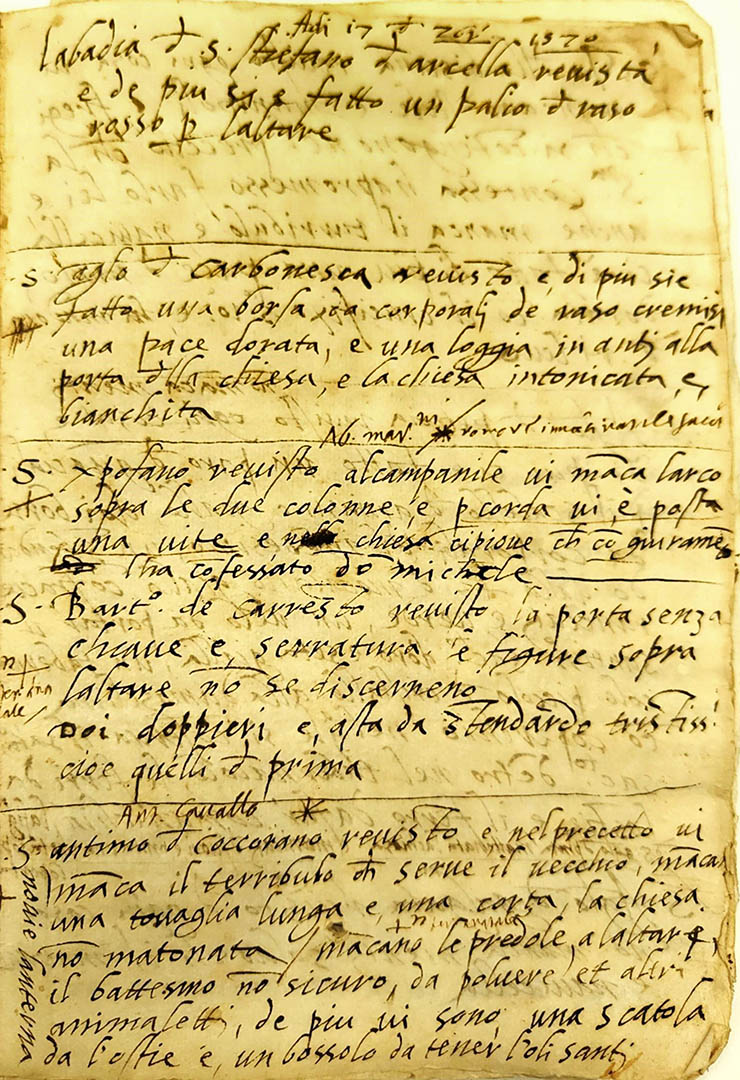
Caresto, 1570: the first pastoral visit
Bishop Savelli visits the parish of San Bartolomeo and the church of San Cristoforo
On 17 September 1570, the subsidiary church of San Cristoforo (Xpofano) in Fanucchio and the parish church of San Bartolomeo received the first pastoral visit organised by Mariano Savelli, Bishop of Gubbio. The sparse notes from his decrees convey an atmosphere of widespread poverty.
The parish priest, or rettore, of this parish was Michele Biniolo who—as we read—was ordered to repair the door, which lacked both key and lock, to restore the frescoes above the altar because they were unrecognisable, and to mend the candlesticks and the banner pole, which were clearly in a state of disrepair.
This document provides the very first description of the decorative and liturgical elements present inside the church of Caresto.
Shelfmark: Diocesan Historical Archives of Gubbio, Visite Pastorali, 19.2 c, Savelli
Venice, 1582: Caresto appears in print for the first time
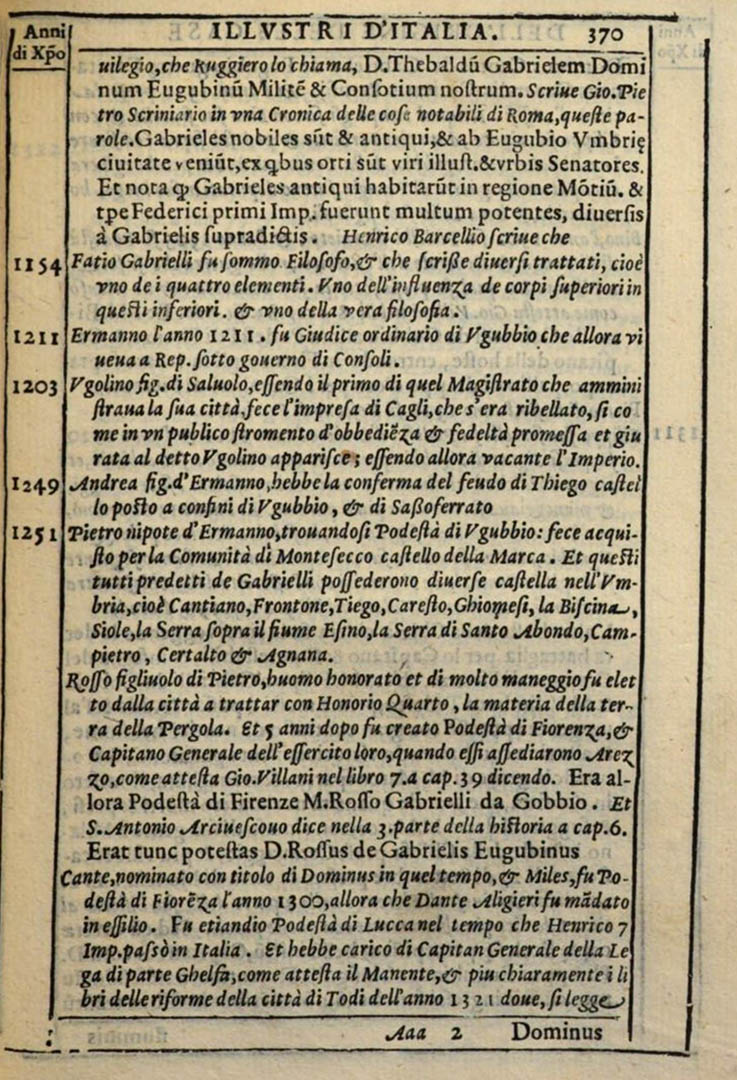
In un volume sulla storia delle famiglie italiane Caresto è tra i possedimenti dei Gabrielli family from Gubbio
Amid the flourishing printing industry of the 16th century, this multi-volume work set out to recount the history of the most prominent Italian families, offering detailed insights into their origins, connections, and alliances.
Among the names of the most celebrated captains and generals features that of the Gabrielli family from Gubbio .
Sifting through the chronological list of this family, upon reaching the year 1251, there is a list of the castles that would come to be owned by them; among these, the Castle of Caresto clearly stands out (followed by Giomici and Biscina).
This marks the very first time Caresto is mentioned in a printed text, extending its renown far beyond the borders of the Gubbio territory.
Shelfmark: Sansovino Francesco (1582). Della origine et de fatti delle famiglie illustri d’Italia.. Altobello Salicato: Venezia..
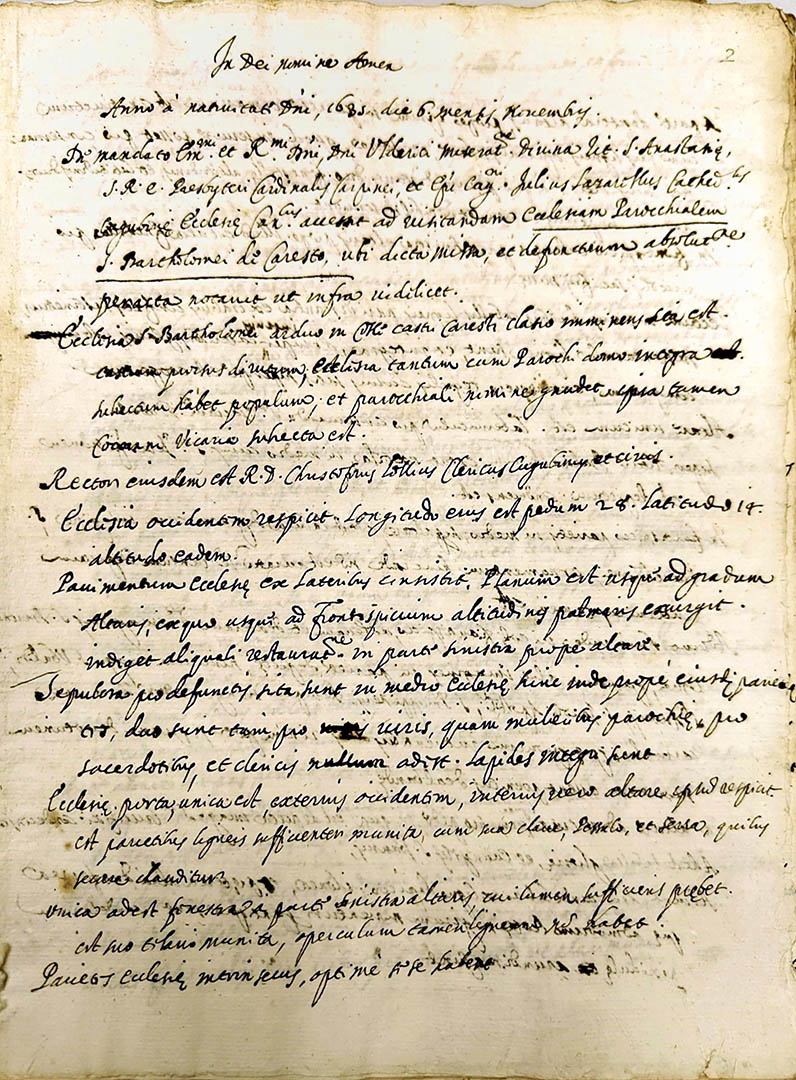
Caresto, 1635: a photographic description
Bishop Carpegna visits Caresto and describes the settlement in meticulous detail
“In the name of the Lord, Amen." Thus begins the report of the visit, written in Latin, dated 6 November 1635, documenting the presence of the Bishop of Gubbio, Ulderico Carpegna, in Caresto. The records accompanying this historic visit represent, to all intents and purposes, the earliest and most detailed description available to us today of the ecclesiastical spaces, the settlement, and its society. In the second paragraph, we read:"The castle is now completely in ruins; only the church, alongside the parish priest's house, remains intact and welcomes a small community. Although it holds the title of parish, it is nevertheless subject to the vicar of Coccorano."
Shelfmark: Diocesan Historical Archives of Gubbio, Visite Pastorali, 19.4 e, Carpegna
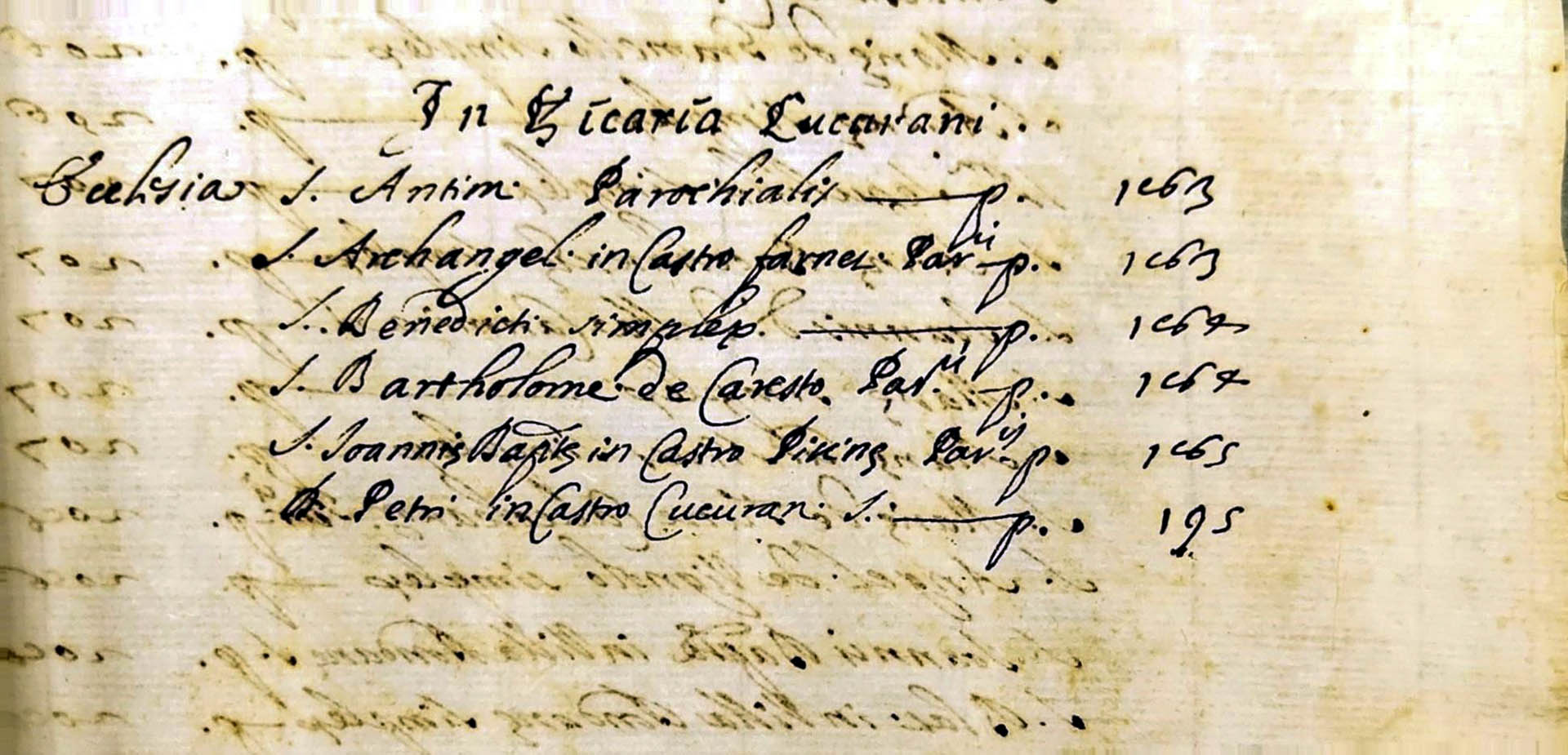
Coccorano, 1642: Caresto and the ecclesiastical parish district
From the index of Monaldi's pastoral visit, the list of the ecclesiastical district
On 20 August 1642, during the episcopate of Orazio Monaldi, the vicariate (vicaria) of Coccorano received a new pastoral visit.
This territorial entity can be compared to a sort of micro-province led by a vicar or provost who administered the jurisdiction on behalf of the bishop.
From the index of the records, we can identify the places of worship structured around this locality: Sant’Antimo, Coccorano (mother church, parish, and seat of the vicariate); Sant’Arcangelo in Castro farnesi, Giomici (parish seat); San Benedetto, Coccorano (subsidiary of the parish of Sant’Antimo); our own San Bartolomeo, Caresto (parish seat); San Giovanni Battista, Biscina (parish seat); and San Pietro, Coccorano (subsidiary of the parish of Sant’Antimo).
Shelfmark: Diocesan Historical Archives of Gubbio, Visite Pastorali, 19.4 i, Monaldi
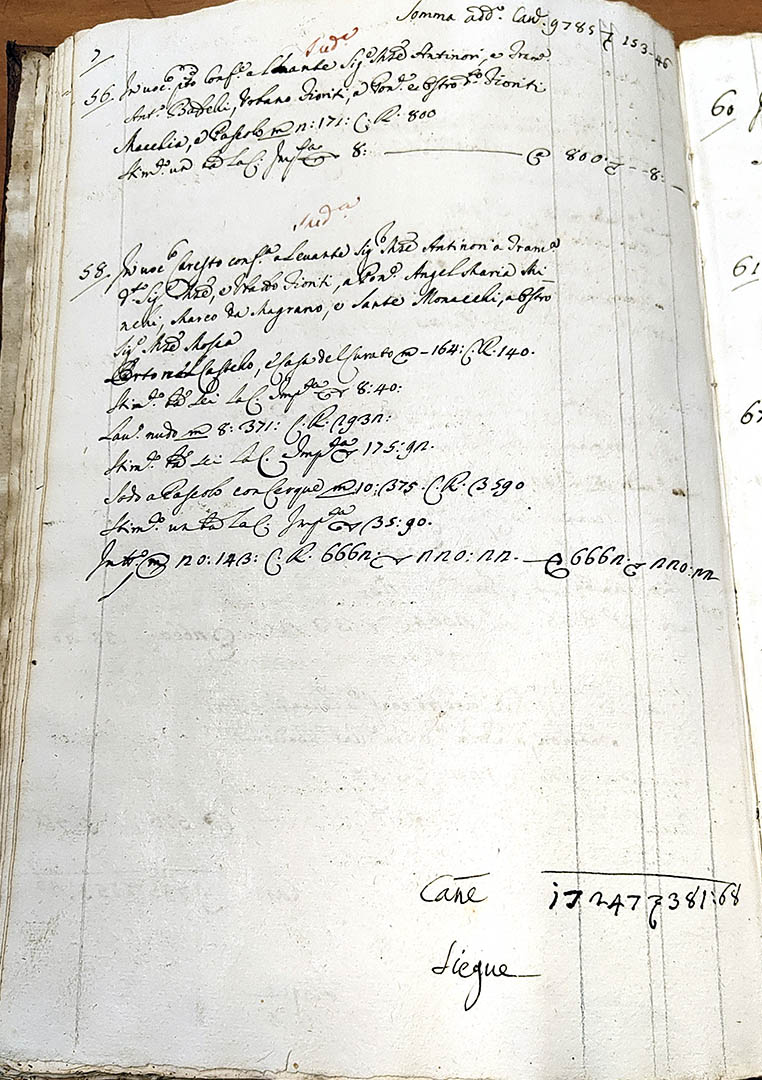
Caresto, 1766: the properties of the church of San Bartolomeo
The precise description of the land registry plots reveals the landowners and land use types
Among the landowners mentioned in the "Brogliardo della Villa di Caresto" (land registry register) produced in 1766, we find the Church of San Bartolomeo.
This was the ecclesiastical body responsible for administering the assets held by the parish and managed by the rector. The total surface area registered to this body amounted to 27 hectares.
The estate linked to the castle included the vegetable garden and the priest's house, covering approximately 1,000 square metres; to the north, a plot of unplanted arable land of around 21,800 square metres; and to the south, an uncultivated pasture with an oak wood of about 26,600 square metres, totalling nearly 5 hectares.
In addition to full ownership of the castle situated at the summit of the Villa di Caresto, the ecclesiastical body owned two further estates within the same territory, named Col di bruscolo and Le Piaggie.
Shelfmark: State Archives of Perugia, Gubbio Section, Brogliardo della Villa, o Parocchia di S. Bartolomeo di Caresto, e Villa di S. Stefano d’Arcella, file 41
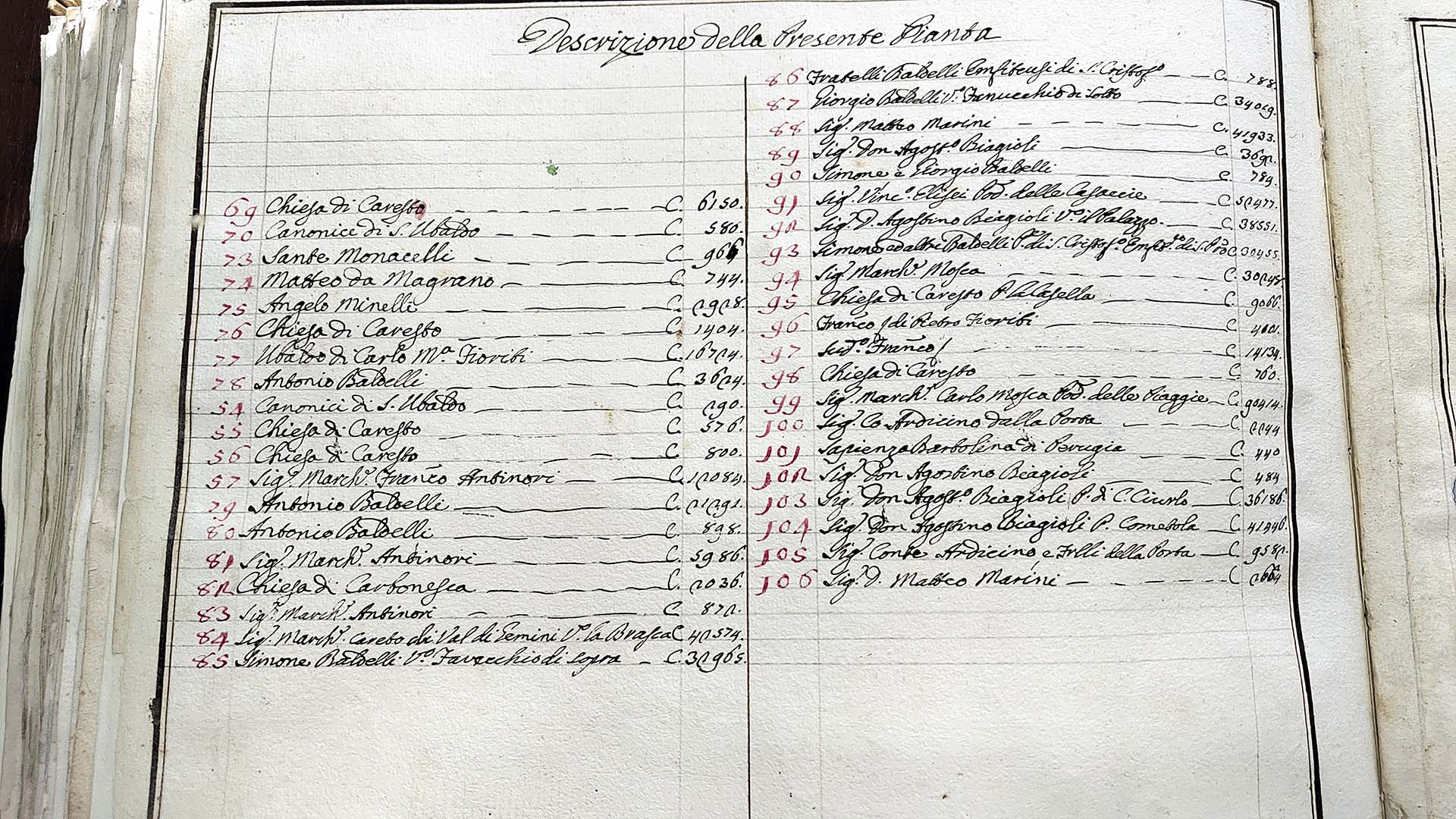
Caresto, 1770: a long list of landowners
The distribution of land registry plots reveals the mosaic of local 18th-century society
Compiled in 1770, this register contains the map of the Villa di Caresto, divided into numbered plots and showing the names of the respective owners.
The territory covers an area of approximately eight square kilometres (making it the twelfth largest in the Gubbio region) and was divided among 33 landowners, with an average holding of 25 hectares each.
The largest landowner by surface area in Caresto was the Marquis Carlo Mosca of Pesaro, who held around 160 hectares, which included several estates known as Valdiboccio, Piano de Saracini, Caipucci, and Le Piaggie. In second place were the Olivetan Monks of San Pietro, with a property of about 120 hectares. The Baldelli family owned nearly one hundred hectares, establishing themselves as the third most prominent local landowners, followed by the Fioriti family.
Shelfmark: State Archives of Perugia, Gubbio Section, Cancellerie del Censo di Gubbio, Catasti antichi, no. 25, 1760-1768, p. 105
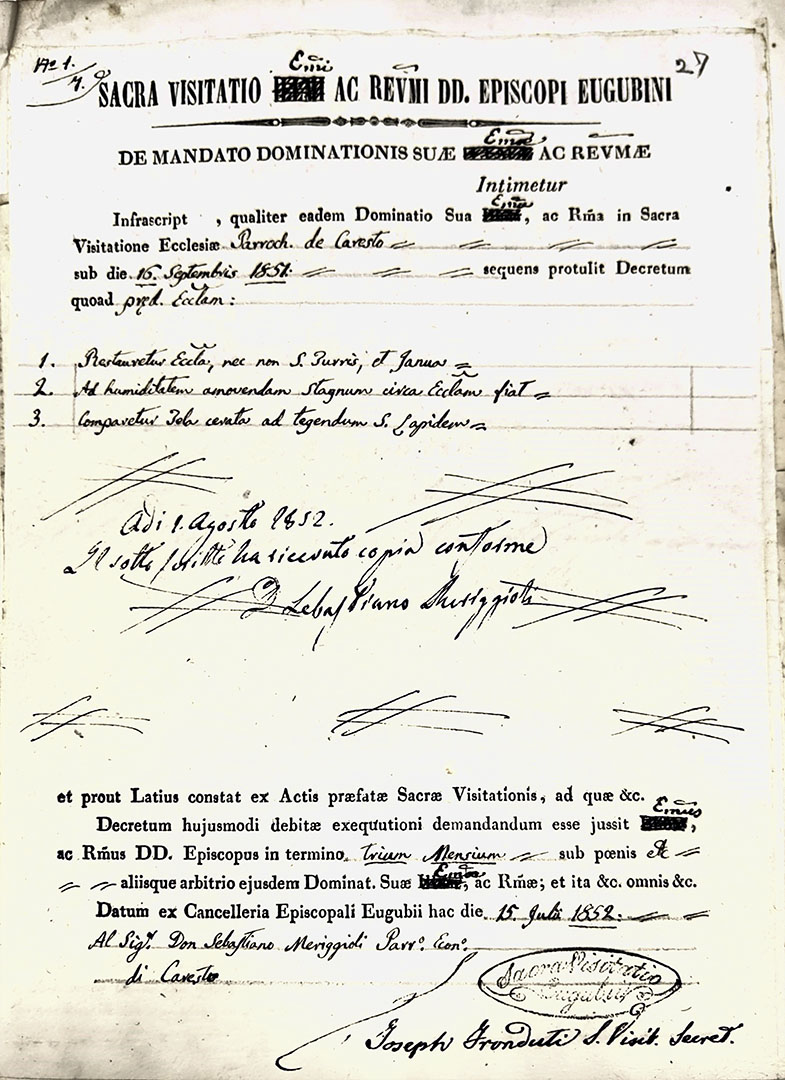
Caresto, 1851: the final visit to the parish of Caresto
Pecci’s visit is the last one before the suppression of the parish of San Bartolomeo
This pre-printed document in Latin contains the concise instructions issued following the visit of the Bishop of Gubbio, Giuseppe Pecci, on 16 September 1851.
The parish priest of Caresto, Sebastiano Meriggioli, received confirmation of the ongoing lack of maintenance of the church, a structural issue already highlighted half a century earlier.
Restoration works were required for the walls, the bell tower, and the door, alongside excavations around the sacred building to mitigate the damage caused by damp.
Likely to counter the decay driven by harsh economic and social conditions, the parish of San Bartolomeo—which also included the church of San Cristoforo—was annexed to the parish of Carbonesca, initially on a provisional basis.
However, the parish's independence would never be restored.
Shelfmark: Diocesan Historical Archives of Gubbio, Visite Pastorali, 19.54, Pecci
© 2026 | All rights reserved | Credits
Daniele Marchetti
Web Development, Design & Graphics
Giorgio Uberti e Roberto Anelli
Content, Photos & Historical Research
Giuseppe Bariona
Coordination & Production