


THE MYTH
Caresto: the mythical Ligurian foundation
According to a legend documented as early as the 17th century, the territory of Caresto was said to have been first inhabited by a colony of Statelli Ligurians coming from Carystum, a fortified village located in the area where the city of Acqui Terme now stands, in southern Piedmont.
In 173 BC, the Roman legions led by the consul Marcus Popillius Laenas launched a treacherous attack and destroyed Carystum.
In memory of the ancient inhabitants—who were later compensated but Romanised—the new settlement was allegedly named Aquae Statiellae.
The legend claims that following this battle, the inhabitants, reduced to slavery, were instead sold to the Romans of Perusia (Perugia) and confined to live and work in agricultural colonies within the mountainous territory overlooking the Chiascio valley.
Naming it after their ancient capital, they are said to have founded Caristo in the Gubbio territory, from which Caresto and Carestello (situated about ten kilometres apart) derive their names.
It is also worth noting the presence of the Hermitage of Caresto in the municipality of Sant’Angelo in Vado (Pesaro and Urbino), about ninety kilometres from our locality, which represents the final remnant of the early-medieval fortress of Caresto, today completely transformed.

Imaginary representation of the defeat of the Ligurians by the Romans
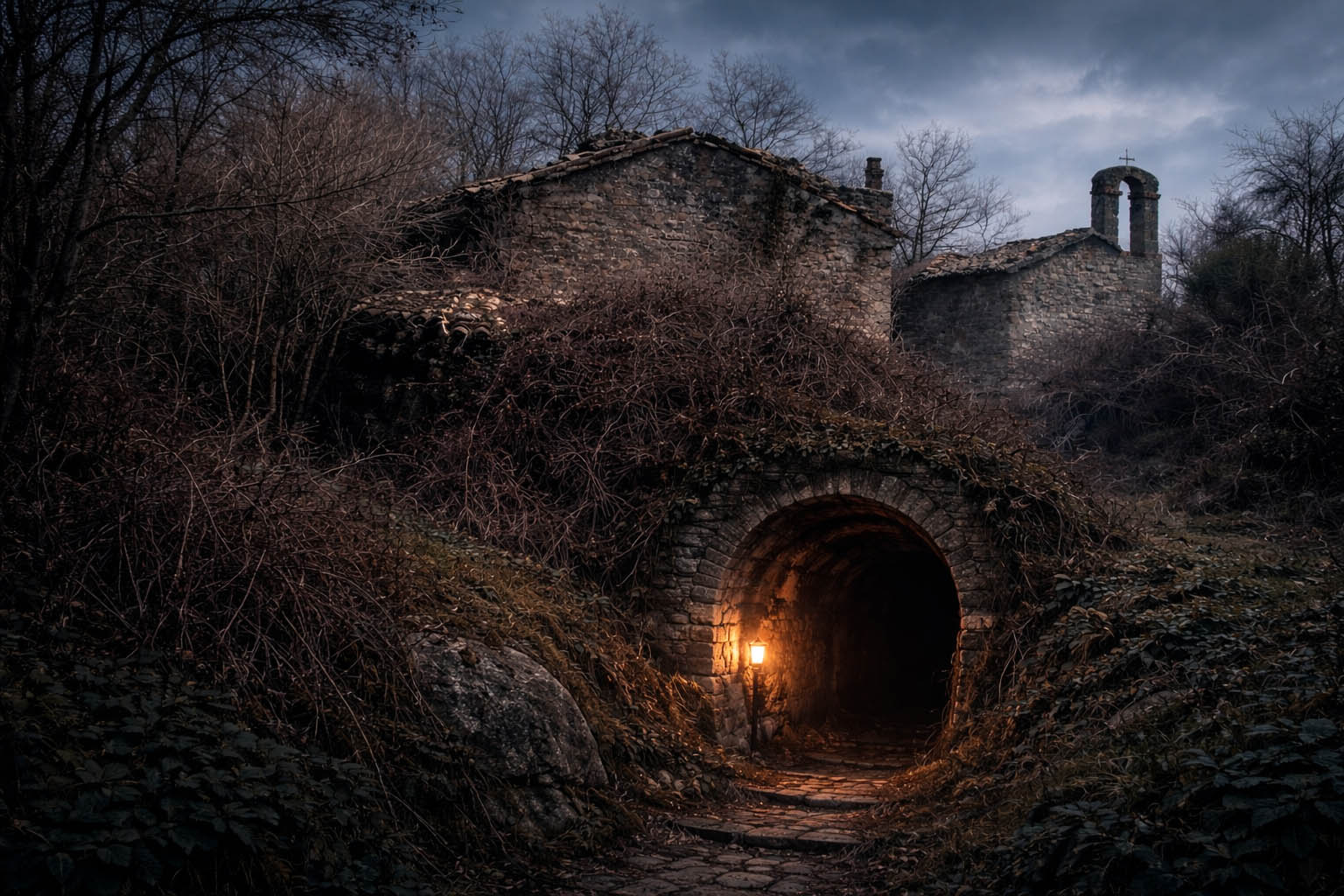
Imaginary representation of one of the entrances to the tunnels
A network of dark, interconnecting tunnels
On the solitary hills at the edges of the Municipality of Gubbio, the Castle of Caresto guards an ancient and almost forgotten secret.
Local lore speaks of a network of underground cavities, excavated during the Late Middle Ages, which supposedly served as escape routes and shelters during sieges, allowing the inhabitants to slip away from enemies through dark tunnels.
These secret passages, it is said, extended as far as the nearby hamlet of Casacastalda, where a fortified castrum once stood: a hidden connection that enabled the castle to maintain vital contact with the surrounding areas even in the most critical of times.
Today, however, no visible trace of these mysterious passageways remains.
No one knows precisely where they are, and no maps exist to mark them. Yet, in the memories of some of the local elders, the recollection of these underground galleries lives on: childhood visions of damp entrances and dark shadows vanishing into the belly of the earth.
It is said that some of these passages were so narrow and cramped they resembled tunnels dug by infernal creatures rather than human hands.
With the passage of time, the tunnels were walled up; children ventured into them all too often, drawn by their mysterious darkness and the echoes of ancient tales.
This secret network between Caresto and Casacastalda, much like the many legendary networks of underground tunnels found in every corner of the Italian peninsula, remains shrouded in mystery, buried in local legends and the fears of a long-bygone era.
In search of the Golden Calf
In Caresto, an ancient castle in Umbria, a legend shrouded in mystery is passed down, speaking of a "Golden Calf" hidden deep within its underground recesses.
This precious idol, coated in gold and steeped in power, is said to be just one of many treasures buried throughout the region—coins, ancient weapons, and ebony relics protected by impassable lands, ruined towers, and forgotten castles.
However, the story of the Golden Calf might conceal an even older and darker connection linked to the Battle of Lake Trasimene, where the Carthaginian general Hannibal inflicted one of the most severe defeats upon the Roman Republic in 217 BC.
It is said that during his advance towards Puglia, Hannibal and his army hid numerous treasures along their path through Umbria, fearing they might be lost to the jaws of war.
Among these, a chariot made entirely of gold, laden with coins and precious armour, is said to have accompanied the legendary idol.
Over the centuries, many attempted to track down the mysterious calf; yet, the few who dared to defy popular belief were driven back by strange omens and inexplicable phenomena.
But the thirst for wealth and the allure of hidden treasure often triumph over fear.
Even in recent years, a few reckless individuals in search of the Golden Calf have caused extensive damage—effectively vandalising the structures of the castle and the surrounding land by digging indiscriminately and scarring the ancient stones.
It is believed that the shadow of an ancient guardian—the devil himself, heir to the god Pluto—watches over this golden calf, protecting it from curious eyes and greedy hands.
And so, the secret remains buried beneath the earth of Caresto, as if Hannibal's precious treasure never wished to return to the light, guarded for eternity by the mysterious force that protects it.
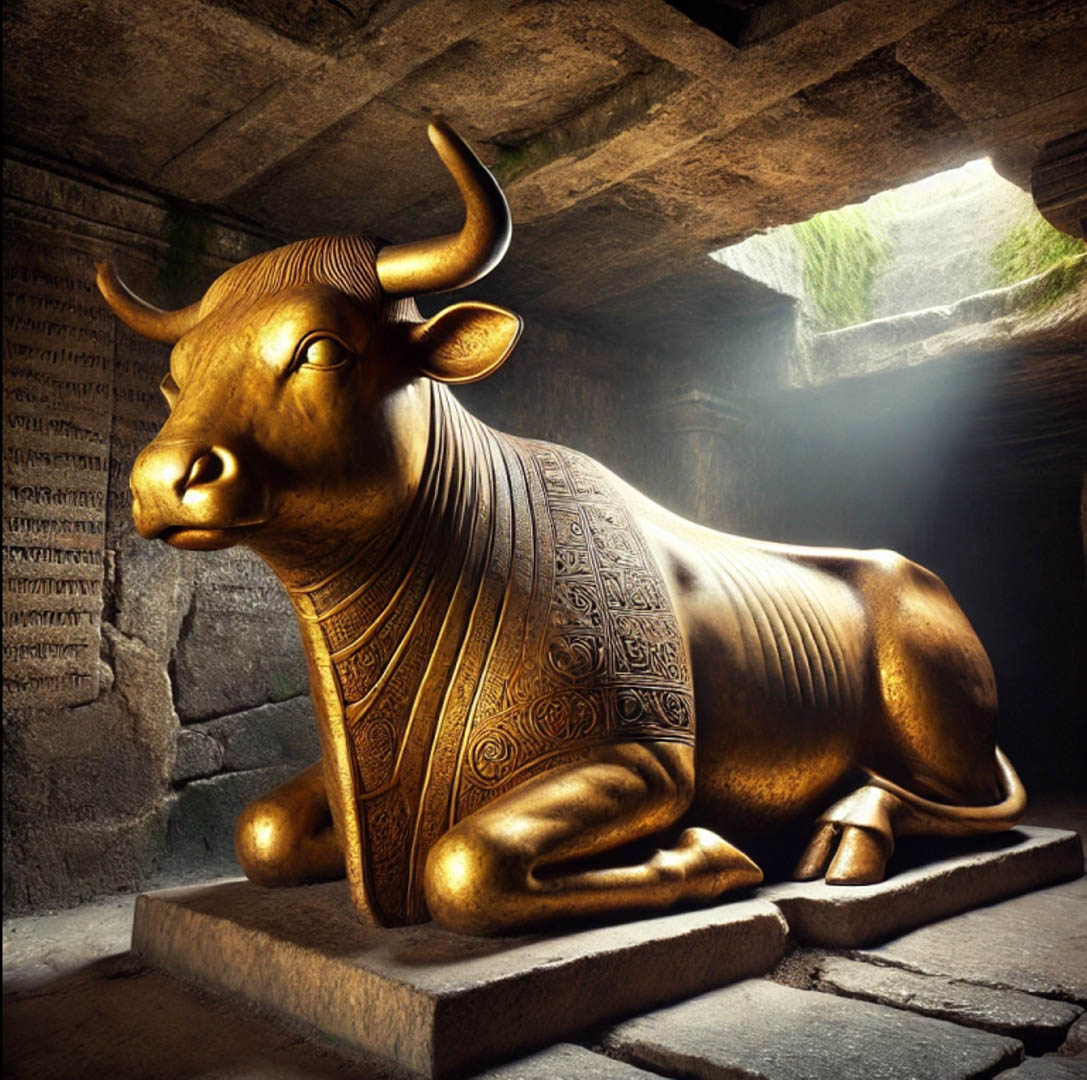
Imaginary representation of a golden calf
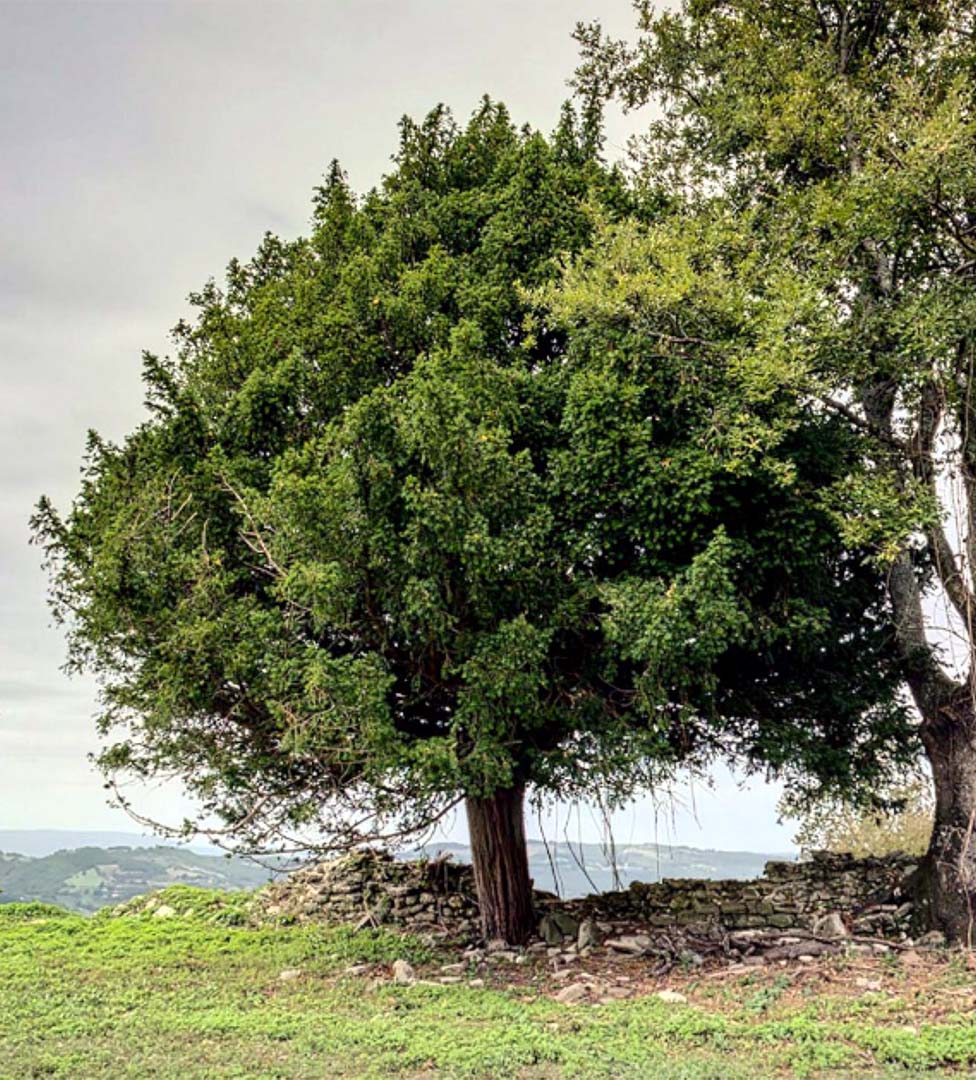
The Taxus baccata growing in Caresto
The Taxus baccata and its magical powers
At the centre of the ancient castle's courtyard stands a solitary and imposing tree: a Taxus baccata, (yew tree) known among the locals as the "tree of death".
This tree, a rare sight in these parts, with its dark foliage and small blood-red berries, has earned a mysterious reputation; since antiquity, its intensely poisonous red berries have inspired tales of their malevolent powers.
According to an ancient local belief, anyone who ingested these berries would be condemned to wander without peace in the realm of the dead, tied forever to the soul of the tree.
Account from the elders of the nearby localities of Carbonesca and Casacastalda reveal that twigs from the tree were once used as amulets at weddings or as decorations during the feast of San Bartolomeo, to whom the church of Caresto is dedicated.
Tradition held that a small sprig of yew was capable of protecting whoever carried it, provided its power was not abused.
Another tale speaks of the bond between the yew tree and the souls of the departed.
It is said that during stormy nights, the tree emits a sort of lament, like a whisper in the wind, as if the souls trapped within its branches had found their voice.
Today, this plant stands like a guardian over the Chiascio Valley, an ancient sentinel silently observing all that occurs between Colpalombo and Valfabbrica.
Who knows how many secrets it has gathered beneath its roots, how many souls it has accompanied on their final journey, and how many legends will yet be born, so long as its shadow continues to protect this corner of the world.
The Knights Templar in Umbria
Between 1145 and 1312, the Knights Templar expanded across Europe and into Umbria, settling primarily along strategic routes for trade, military control, and pilgrimages. This period opened with the papal bull Militia Dei issued by Pope Eugene III, which granted them autonomy and property rights, and concluded with Clement V’s Ad Providam , which transferred their assets to the Hospitallers following the suppression of the Order.
In Umbria, the Templar presence is documented in various towns within the province of Perugia (such as Scheggia, Fossato di Vico, and Sigillo), along the route heading towards the Adriatic coast.
In Perugia, the assignment of the church of San Gerolamo (1243) and the foundation of San Bevignate testify to a significant entrenchment, which was also linked to the political and economic control of the area.
The situation in Caresto, in the upper Chiascio valley, is quite different.
Despite its potentially strategic location, there is a total lack of documentary evidence pointing to any significant Templar presence.
The area was under the control of Gubbio and dominated by well-established religious institutions, particularly the Benedictines (the abbey of Vallingegno, San Pietro, etc.), which restricted the expansion of other orders.
Documents from 1217 and 1312 link Caresto to the defensive system of Gubbio, making no reference whatsoever to the Templars. Even during the trial against the Order (1310), which took place in Gubbio, local figures emerged but no connections to Caresto were found.
The idea of a Templar presence in Caresto stems more from modern interpretations, influenced by esoteric and media-driven narratives, rather than from concrete historical data.
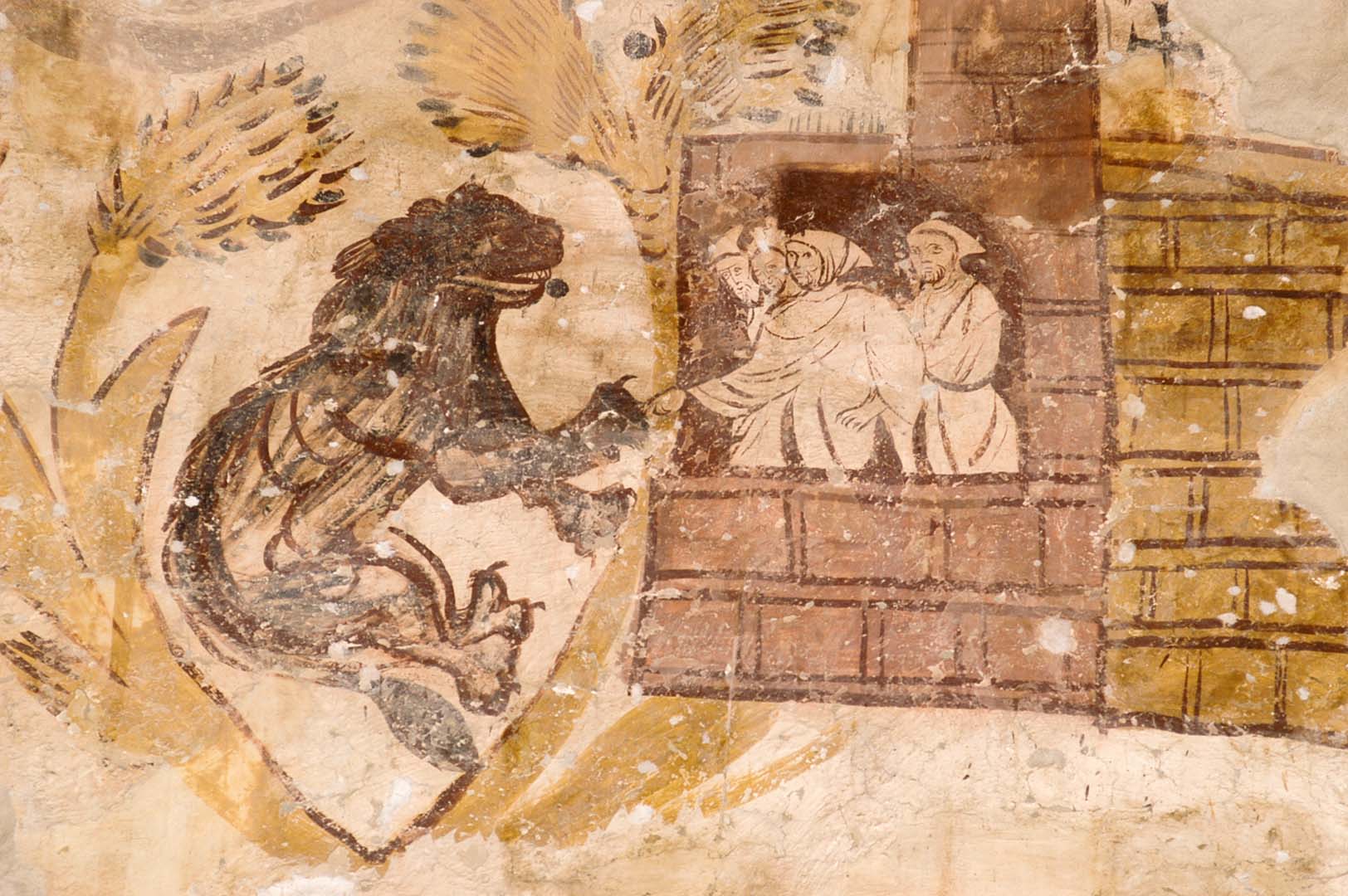
Fresco (1260–1270) depicting a lion and Templar monks in the church of San Bevignate (Perugia)
© 2026 | All rights reserved | Credits
Daniele Marchetti
Web Development, Design & Graphics
Giorgio Uberti e Roberto Anelli
Content, Photos & Historical Research
Giuseppe Bariona
Coordination & Production