


THE TERRITORY
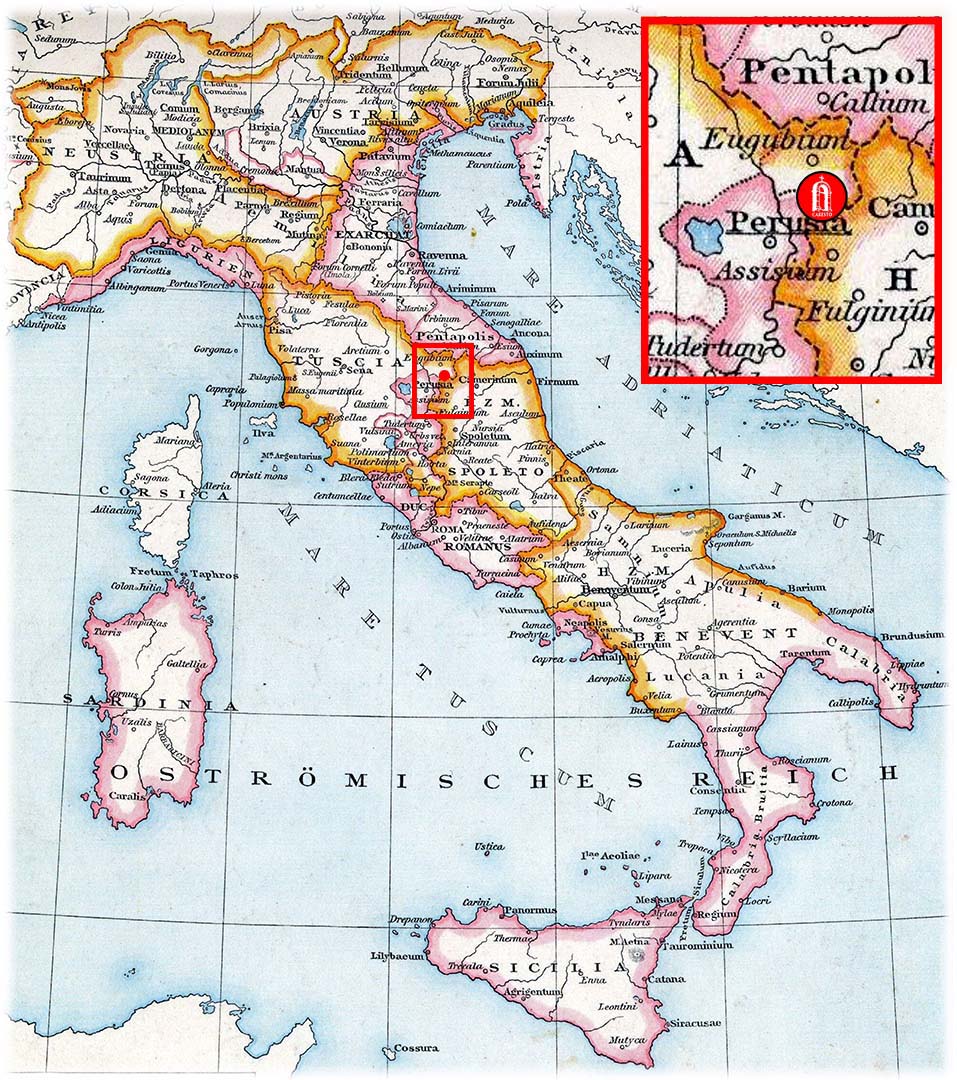
Italy, 616: the Chiascio river between Constantinople, Ravenna and Rome
Lombard possessions in Italy at the beginning of the 7th century.
The Lombard Kingdom (Neustria, Austria and Tuscia) and the autonomous duchies of Spoleto and Benevento. The map shows the extent of the Lombard domains at the time of Agilulfo's death (616).
The territory of the Upper Chiascio (Alto Chiascio) was situated along the ridge of the Byzantine Corridor, a narrow mountain strip controlled by the Romans (Byzantines), featuring fortified castles such as Narni, Amelia, Todi, Perugia and Gubbio, some of which were located along the Via Amerina.
The Via Flaminia, although more accessible, was already under Lombard control.
Shelfmark: Italien zur Langobardenzeit (Italy in the time of the Lombards). Allgemeiner Historischer Handatlas. Johann Gustav Droysen, 1886.
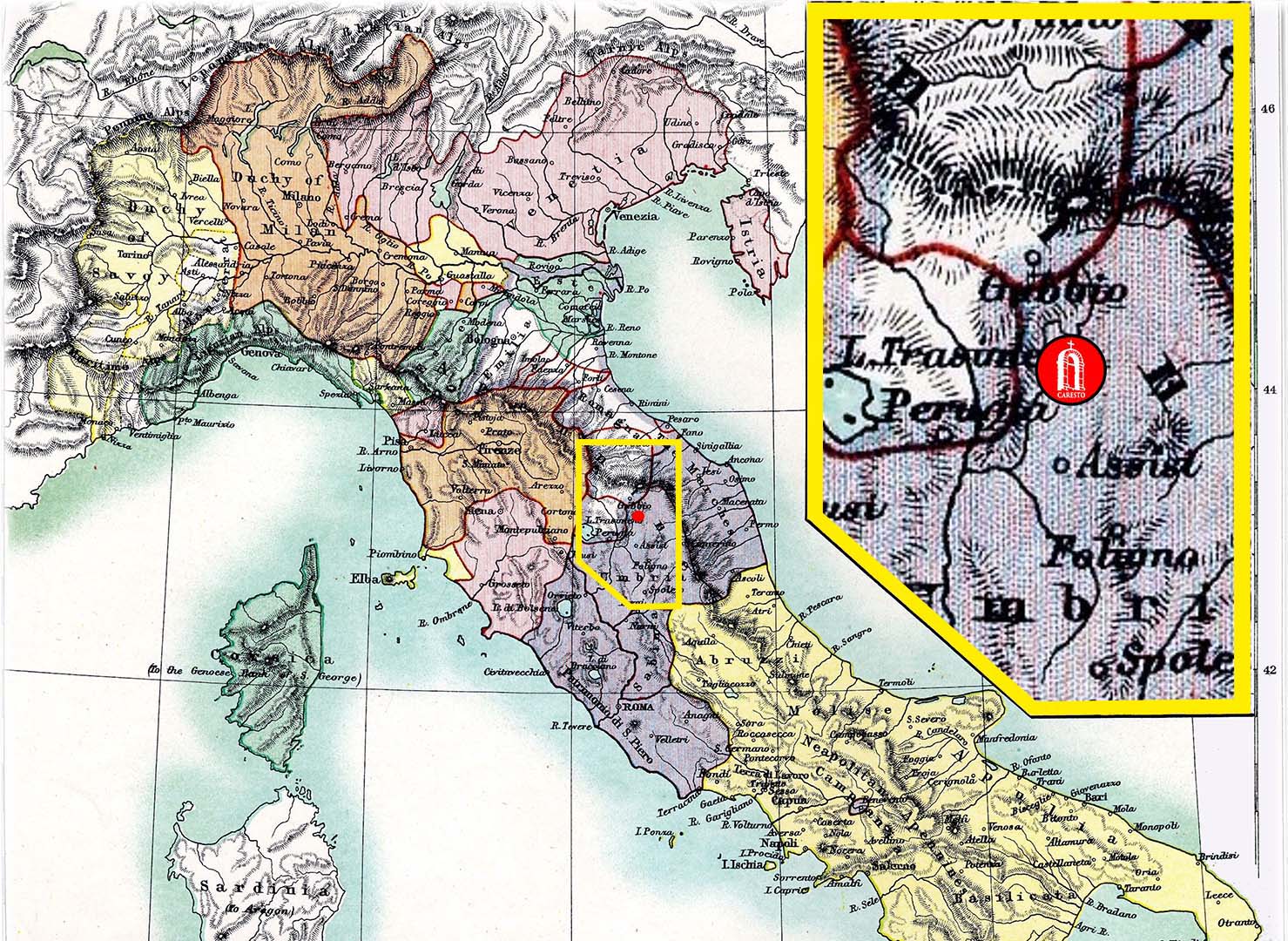
Italy, 1454: between the Da Montefeltro and the Pope
On 25 April 1443, during the short-lived "signoria" (lordship) of Oddantonio da Montefeltro, the County of Urbino—which also included Gubbio and, consequently, Caresto—was elevated to the status of a duchy by Pope Eugene IV.
Oddantonio’s rule was brief, coming to a tragic end on the night between 21 and 22 July 1444.
He was succeeded by his half-brother (historically identified as his cousin), Federico da Montefeltro. Over nearly forty years of governance, Federico would transform the Duchy of Urbino into one of Italy's foremost artistic and cultural hubs, second only to that of Lorenzo the Magnificent in Florence.
Shelfmark:Historical Atlas of Modern Europe, Oxford: Clarendon Press, 1902.
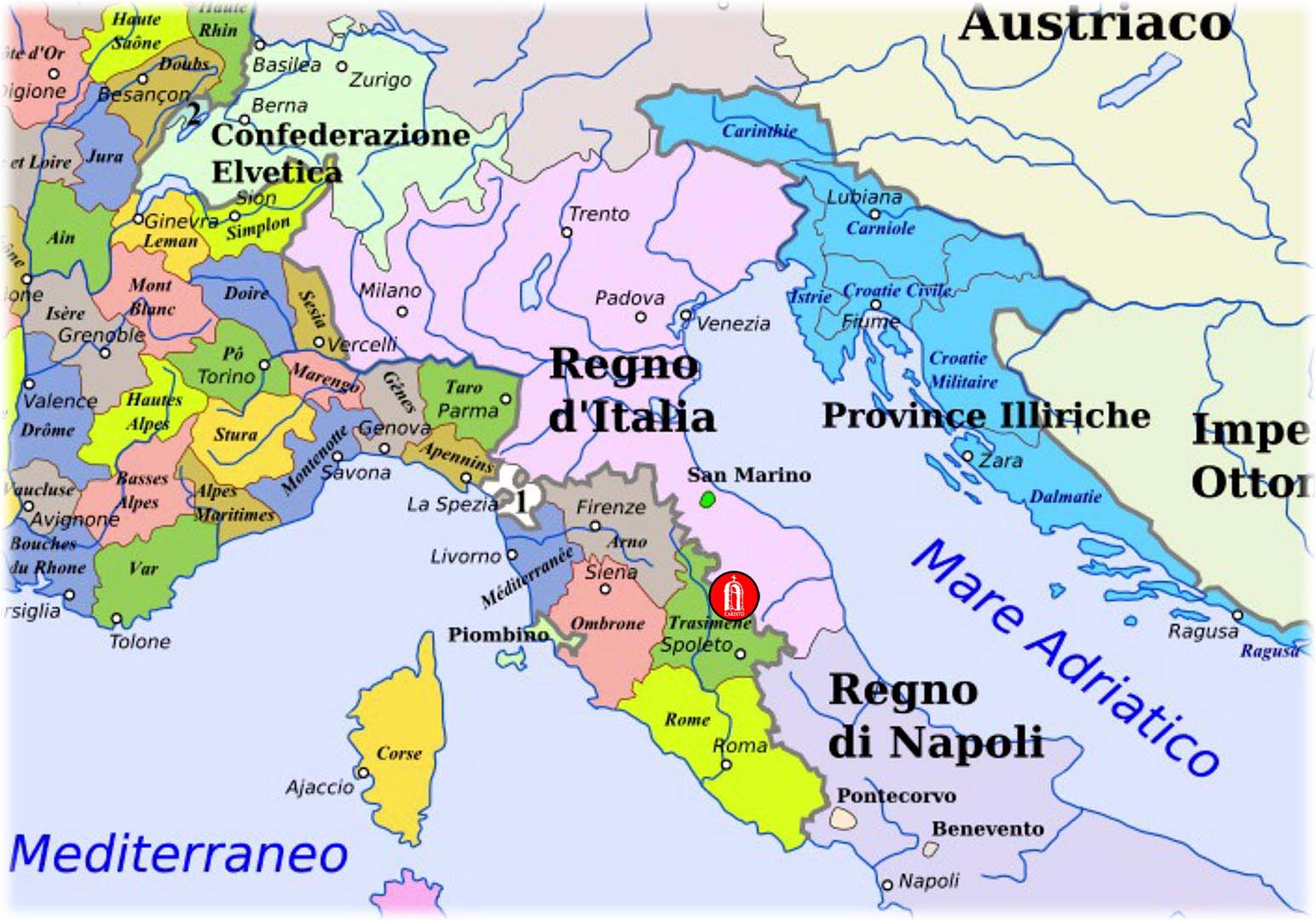
Shelfmark: Administrative divisions of the First French Empire (1812), 2008, from the Cambridge Modern History Atlas, 1912.
Italy, 1812: between the Kingdom of Italy and the French Empire
In 1798, Gubbio was occupied by the newly formed Cisalpine Republic and, for a few months, became part of the Department of Trasimeno within the Roman Republic.
Ten years later, Napoleon decreed that the Papal Provinces of Ancona, Camerino, Macerata and Urbino were to be annexed to the Kingdom of Italy, with Milan as its capital, and Gubbio was placed under the Department of Metauro.
Just a few metres from Caresto ran the border with the Department of Trasimeno, which was already subject to the First French Empire.
With the third Papal Restoration, proclaimed on 25 July 1815, the territory fully returned to the Papal States under the Apostolic Delegation of Urbino and Pesaro.
© 2026 | All rights reserved | Credits
Daniele Marchetti
Web Development, Design & Graphics
Giorgio Uberti e Roberto Anelli
Content, Photos & Historical Research
Giuseppe Bariona
Coordination & Production